
Farming
Early History
The earliest evidence of agriculture in Hartley dates back to Roman times. A farmhouse of 1st/2nd century AD date was discovered when the Wellfield Estate was being built. Bones of pigs, sheep and cattle were found in a ditch.
From the Domesday Book we learn that the village had a cultivated area of 600 acres and "wood for 10 pigs" (probably the 25 acres of Foxborough Wood). It is clear from place name evidence that the land in this area had to be won by the new settlers. The "ley" element in Hartley, Idleigh and Ridley suggests clearance of land, as did the names of some of Hartley's fields.
The Middle Ages
We can gain a glimpse of the crops grown in Hartley in 1296, because the taxes in that year were paid in corn, to be taken to the king's army in Gascony. The collectors received 18 bushels of wheat and 4 bushels of oats from Hartley. A reflection of the predominance of wheat locally (historically people have always preferred wheat bread to that of any other grain).
The first detailed description of farming is a survey of the lands owned by the manor (Hartley Court) in 1392. The picture is one of mixed farming with an emphasis on arable. It mentions 206 acres of arable land, 5 acres of grass for hay, an orchard, garden and pasture land. Wheat is likely to have been the main crop.
This survey also suggests that Hartley once had two open fields: (1) The Rede, which probably included all the land between Ash Road and Church Road; and (2) Northfield, which appears to have lain to the north of Church Road and Manor Lane. Kentish open fields were not like the so called "classic" open field system, for it is believed that the farms owned blocks not strips and that they were subdivided by temporary brushwood enclosures (mentioned in a 14th century survey of Hartley manor). It is certainly striking how most of Hartley's farms owned land on both sides of Church Road, with the exceptions of Hartley Wood Farm and Fairby, both on the edge of the manor.
The Early Modern Period
What evidence there is suggests that mixed farming (weighted towards arable) continued up to the last century. In a court case in 1560 William Middleton, the tenant of possibly Hartley Wood Farm said he had planted 60 acres with wheat, barley, oats, beans, peas and tares. And three probate inventories from the 1600s give a good impression of farming then:
- Henry Middleton (Hartley Wood Farm, 1666): Wheat (51 acres); barley (17a); oats (18a); peas (15a); grey peas (11a); "pease more" (8a); 10 horses, 10 pigs, 4 cattle, 76 sheep.
- Thomas Young (Fairby, 1688): Wheat (35a); barley & oats (28a); peas and tares (17½a); clover and sainfoin for mowing; 38 sheep; 12 cattle; 4 pigs; 8 horses.
- James Burrow (New House Farm, 1695 - part of?): wheat in fields and in barn; also barley & peas, 6 cattle, 5 sheep, 4 pigs, 1 horse.
Victorian Era to Date
It is not until the 19th century that we get a more detailed picture of farming in Hartley, thanks to the tithe survey and especially the annual parish returns from 1867. In 1901 the sale catalogue in Dartford Library of the Hartley Manor and Fairby estates gave the land use for practically the whole parish.
Selected years for the annual parish returns, together with the 1843 returns from the Tithe File: Agricultural Statistics 1843-1987.
The tithe file for 1843 also gives us an idea of crop yields then. That year the average yield for wheat was 22 bushels per acre. Today, with the tremendous advances in productivity, UK farms produce about 120 bushels per acre (about 7.5 tonnes per hectare).
At the time of the Tithe survey in 1844, the age of "high farming", arable predominates, and this continues until the 1870s when a nationwide depression set in. In common with elsewhere Hartley's farmers responded by increasing land devoted to pasture and orchards, reflected in the 1901 land use map. Hops were grown on a smallish scale until the 1890s, as well as the Fairby Oast House, New House Farm had a hop kiln.
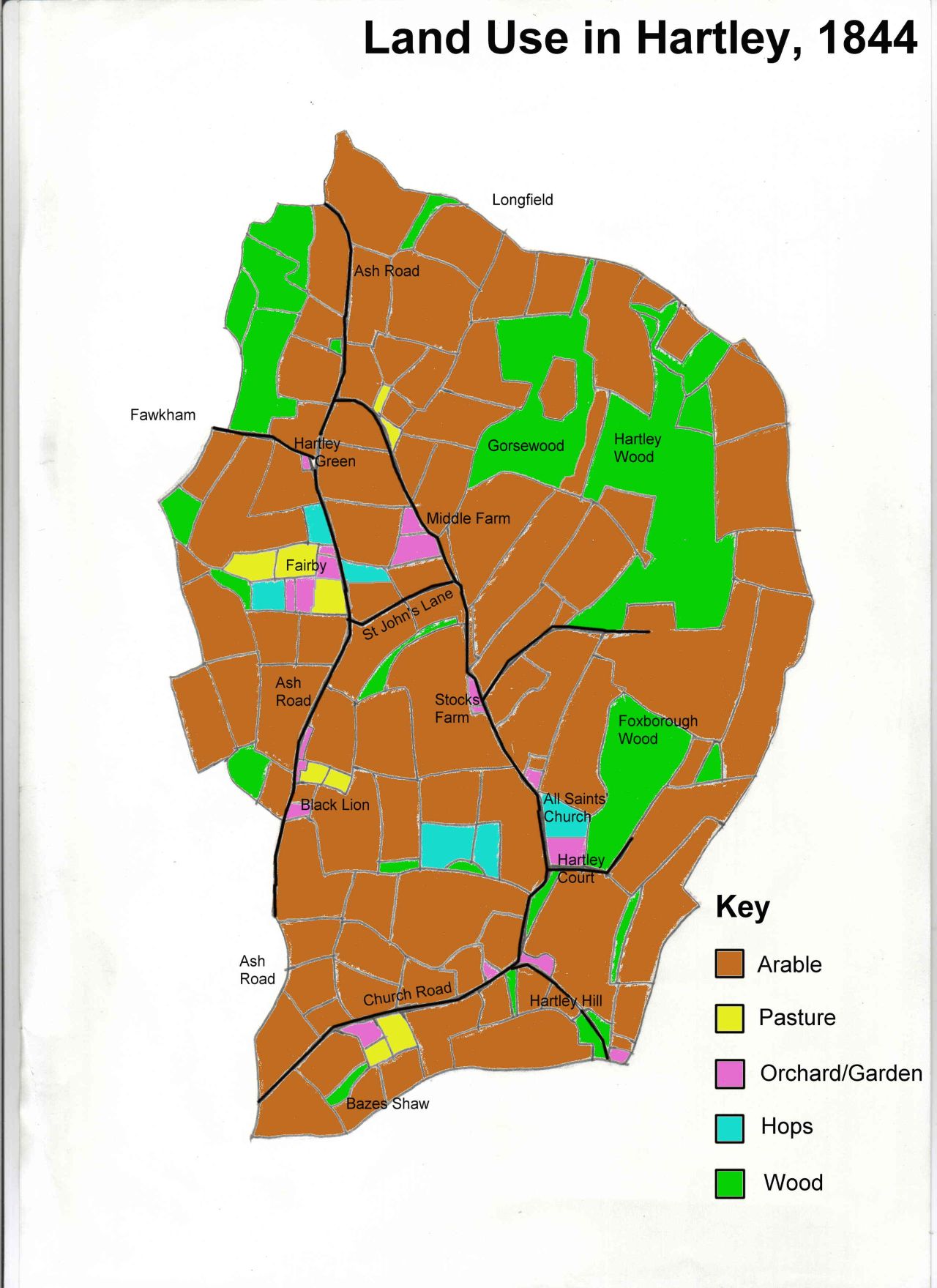
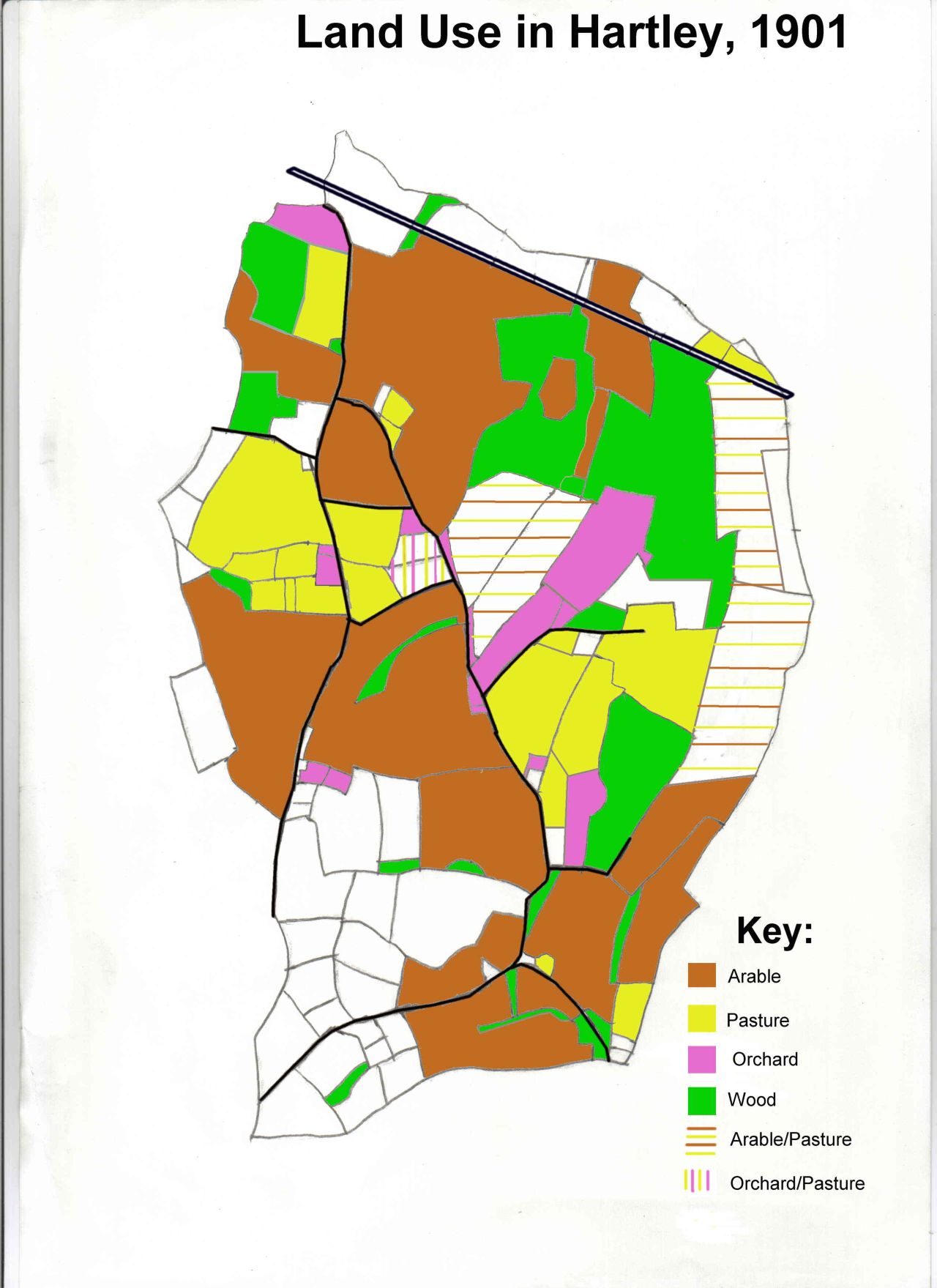
The purchase of the Hartley Manor and Fairby estates by Smallowners Limited in 1912 wrought huge changes in agriculture. The number of farm holdings increased from 10 in 1907 to 49 in 1915, over half less than 5 acres in size. The smallholders brought an increase in acreage devoted to orchards, vegetables and soft fruit. Even with the national campaign to grow more food the overall acreage devoted to crops and grass in Harley fell from 706 acres in 1914 to 382 acres in 1918.
Between the wars there was a massive decline in arable acreage - the result of the lowest grain prices for 150 years, by 1937 arable crops covered just 10 acres. The years of the second world war saw this trend reversed as farmers were encouraged to plough up grass fields and to plant crops previously imported (eg. 3½a of sugar beet in 1944). Hartley played its part in digging for victory; the total area under crops and grass grew from 205 acres in 1937 to 418 acres in 1944. There were new sources of labour too - land army girls and prisoners of war.
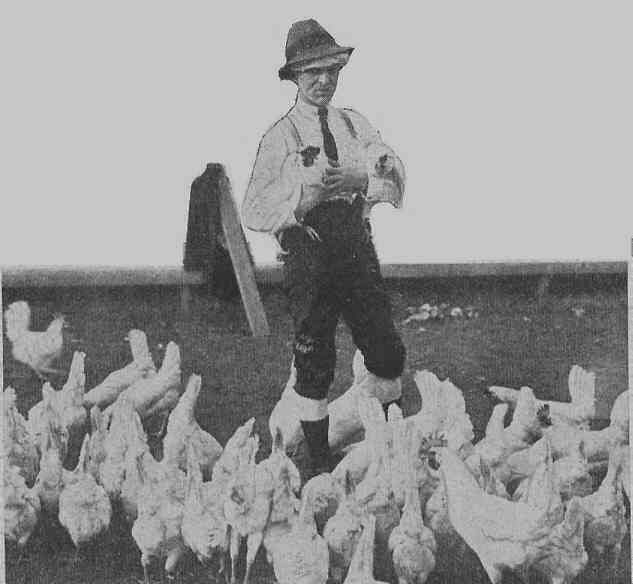
A Hartley poultry farmer in 1915
Since the war much land has been lost to housing, most notably when New House Farm (which was good agricultural land) was lost to New Ash Green. At the turn of the century, about 900 acres were cultivated, but now there are little more than 300 acres in farming and much of that Hartley only acquired in 1987 when the rural part of Longfield south of the railway was added to the parish.
In 1987 there were 11 agricultural holdings in the parish, but only Hartley Bottom Farm is of any size.